
Book Review | Doorknob: Bombshells in Therapy
The Deadline, the Brain, and Why it is Important to End on Time
Section Editors:
Serena Wadhwa & Omewha Beaton
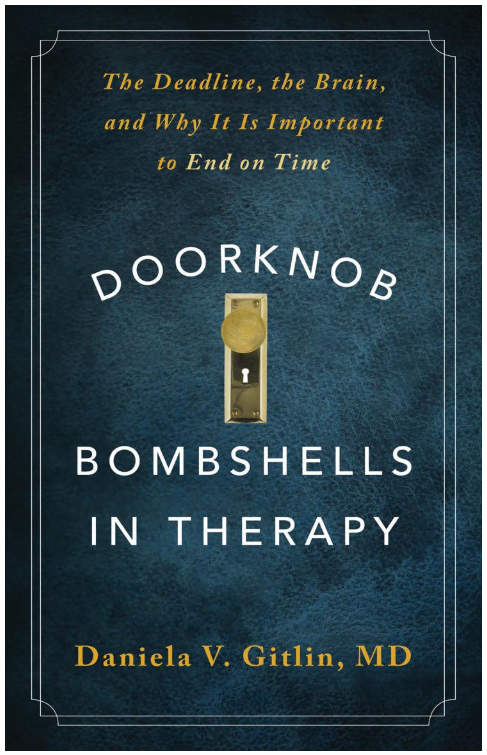
Daniela V. Gitlin. (2024). 240 pages.
ISBN 978-1-324-05259-3 (paperback).
W. W. Norton Professional Books.
What do you do when your patient is about to walk out of the therapy room, and when their hand is literally on the doorknob, they turn their head over their shoulder and with a deep breath reveal a significant issue that should be addressed? Do you make the time to process the issue? Do you hesitate and the patient walks out the door? Do you do nothing and let the session end? Do you acknowledge the issue, but still end the session?
Doorknob: Bombshells in Therapy by Daniela Gitlin aims to answer the question: What is a practitioner to do when a patient announces a serious issue just as they are leaving the room at the end of the session? Spoiler alert: end the session. At length, the book and Gitlin spend the majority acknowledging that ending the session is the most therapeutic technique to use (under most circumstances, as with anything, using clinical judgment is paramount). At 178 pages, Gitlin, having used the absolute dearth of science available on the topic, basically announces the answer to the question at the beginning of the book (so it’s not really a spoiler).
What started as a commentary in the Psychiatric Times in 2022 about the phenomenon is extended out to a short full-length work. Gitlin starts out strong, addressing whether it is therapeutic or not to end on time. Again, the book does its best addressing the research available, which is extremely limited. The book comes to a screeching halt when Gitlin spends 30 pages discussing left/right brain specificity and none of it is related to Doorknob moments. This, then, extends out to an overwrought metaphor of the patient being left- or right-brained, the therapist being the left- or right- brained, the session being a novel (I guess technically it could be any piece of art, but since Gitlin is writing a book, a novel it is), but then each person having to deal with their own left versus right brain dichotomy. This metaphor seems just a bit too stretched out to be really meaningful. Gitlin’s original commentary is brisk, tight, no filler, utilizing the same references in her full-length book. But what works in a short commentary does have difficulty being sustained in the book. The commentary has two different case studies, with the book having a few more, but only a handful actually relate to the topic of a Doorknob moment.
These moments can be terrifying for any practitioner and needs to be addressed on why they occur, what is best practice in handling them, and what does it mean for the patient to announce the comment at all. Gitlin does a decent enough job condensing the available research on what to do, provides concrete and clear techniques to use, and has a clear stance on why the session should be ended. Perfect for a commentary, but any practitioner looking for a deeper look can easily just stick with the commentary, available for free at the time of this review online. Does that mean the book is for patients? No. A reader does not get the idea that the book was written specifically for lay persons to understand a concept described by professionals. And here is where the book shines, but not for too long. Gitlin speaks with others, a dentist and financial advisor, on what their experiences were with Doorknob moments. Extremely limited, but utterly fascinating, these individuals give their experiences and techniques for how they deal with the issue and with the consequences they had to contend. One wishes for an expansion on this section, taking up one page in the book, but could have been a fascinating qualitative undertaking of an issue prevalent in arenas outside of psychology and psychiatry (medicine in general).
The work picks back up with a coda focusing on the transition to virtual therapy due to the pandemic. Again, another opportunity to explore the Doorknob in a virtual setting, but with only one case study, the chapter is left to explore more of the nuance of quality therapy using telecommunication versus in-person.
Gitlin’s book never outright says that this work is the definitive work on the issue, but it has some truly interesting ideas of how and why it manifests that it spends no time delving into. It provides the most up to date information, but that is also found in her commentary. The book is easy to read and does not bog itself down with technical jargon, making it accessible to anyone that picks it up. The metaphors it uses are stretched to their absolute limits and can, at times, seem a bit overdone.
A small compendium of the research related to a distressing situation that any clinician experiences will take up little room on the bookshelf. But this book also demonstrates that there is still more progress that needs to be made as to why a person reveals material clearly needing more processing at a time when no processing can be done.
Reviewer: John Delatorre, PsyD, MJur